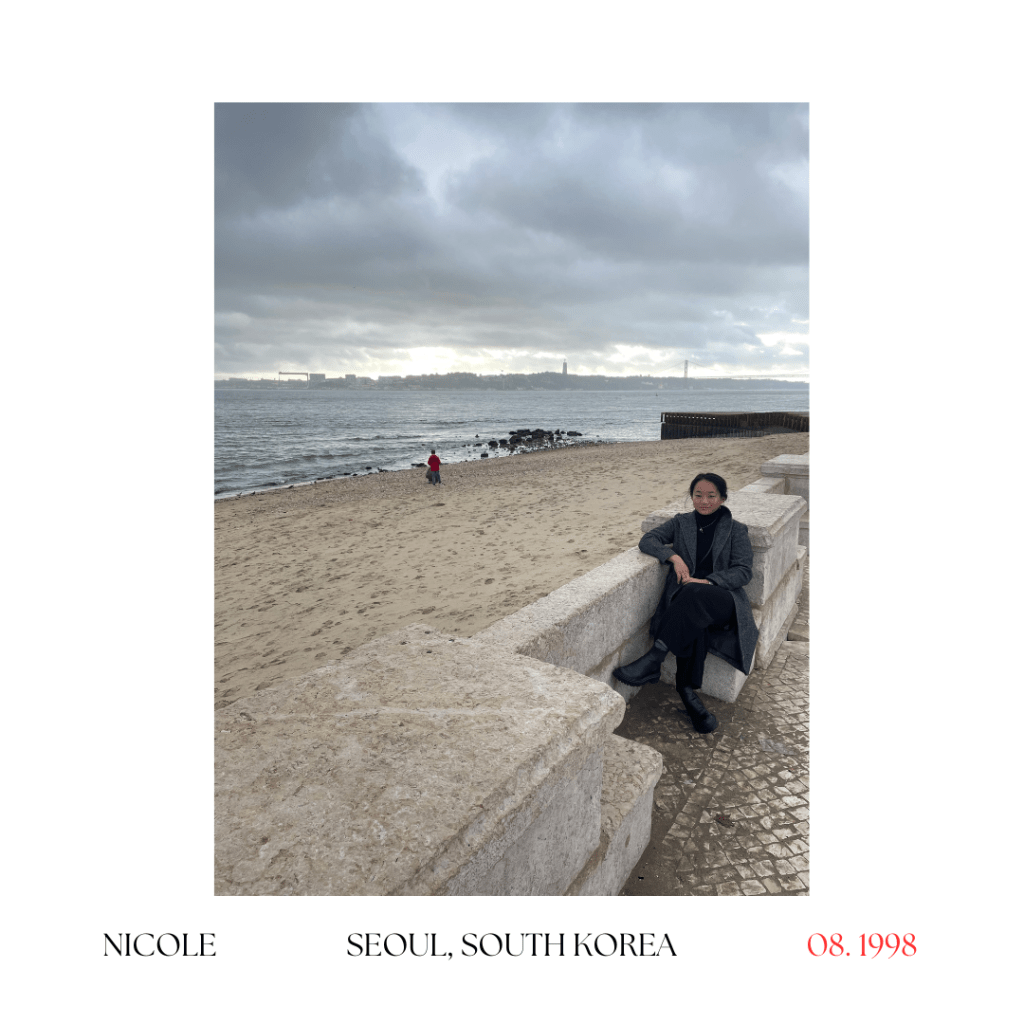
Nicole
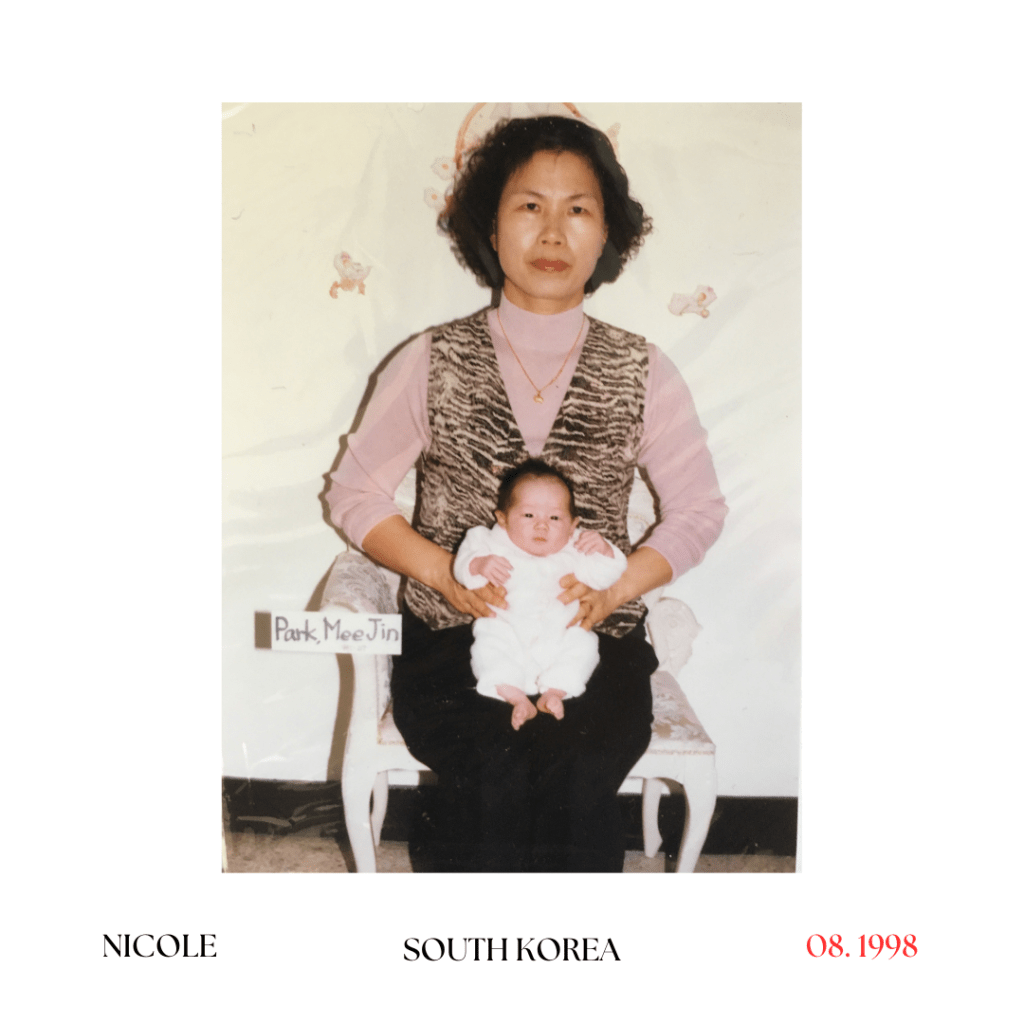
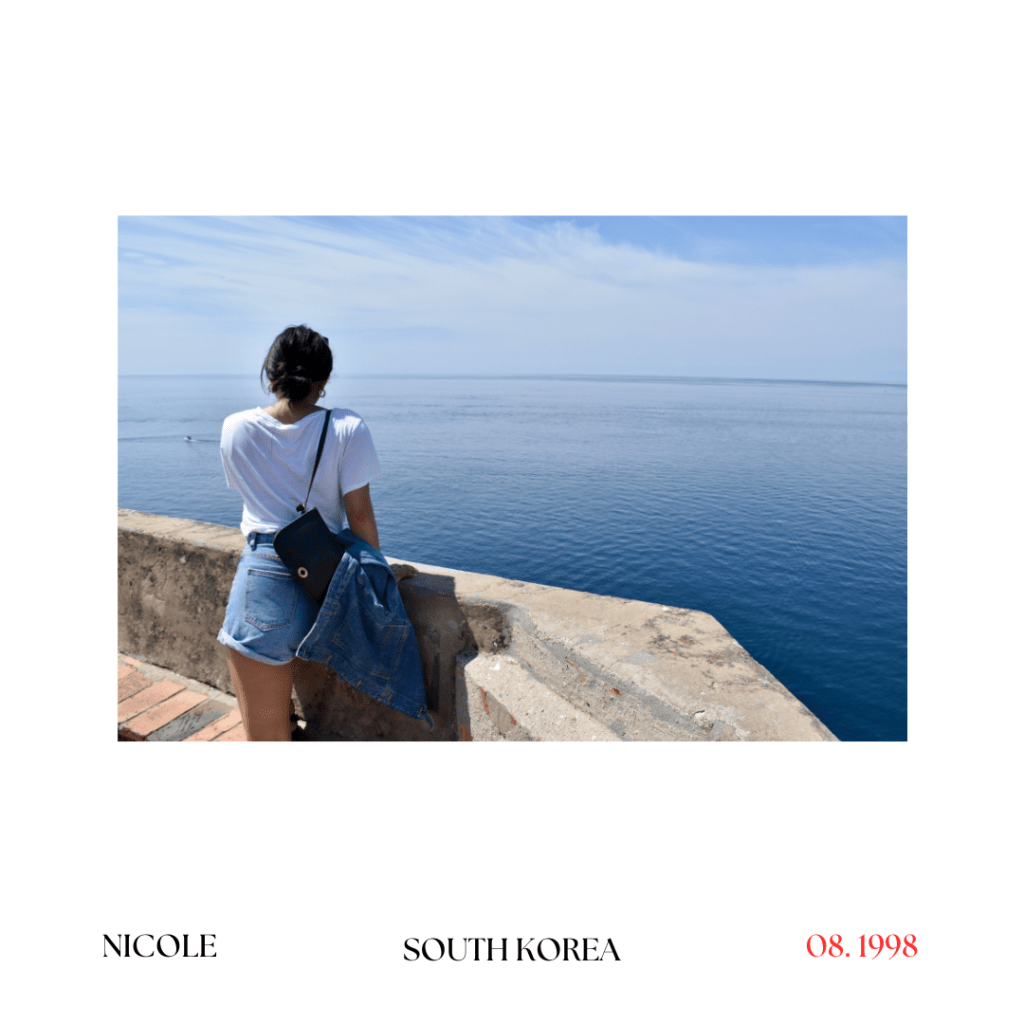
I grew up in Blaine, Minnesota, but I currently live in France for a Masters program. I was 5 months old when I was adopted from Seoul, South Korea.
I grew up in a supportive family with a sister who is biological to my parents. I went to a private catholic school for elementary and middle school which was predominantly white. That was really challenging because I didn’t fit in and I felt like I stood out. I remember wanting to look different than I did, I didn’t fit the beauty standards or have the same color hair as the other girls and that hurt. All of that to say, I’ve known I was adopted for my whole life. The spectrum of feelings that surround adoption have only resurfaced within the past two years so a lot of these feelings I am recounting were really difficult if not impossible for me to name when I was young.
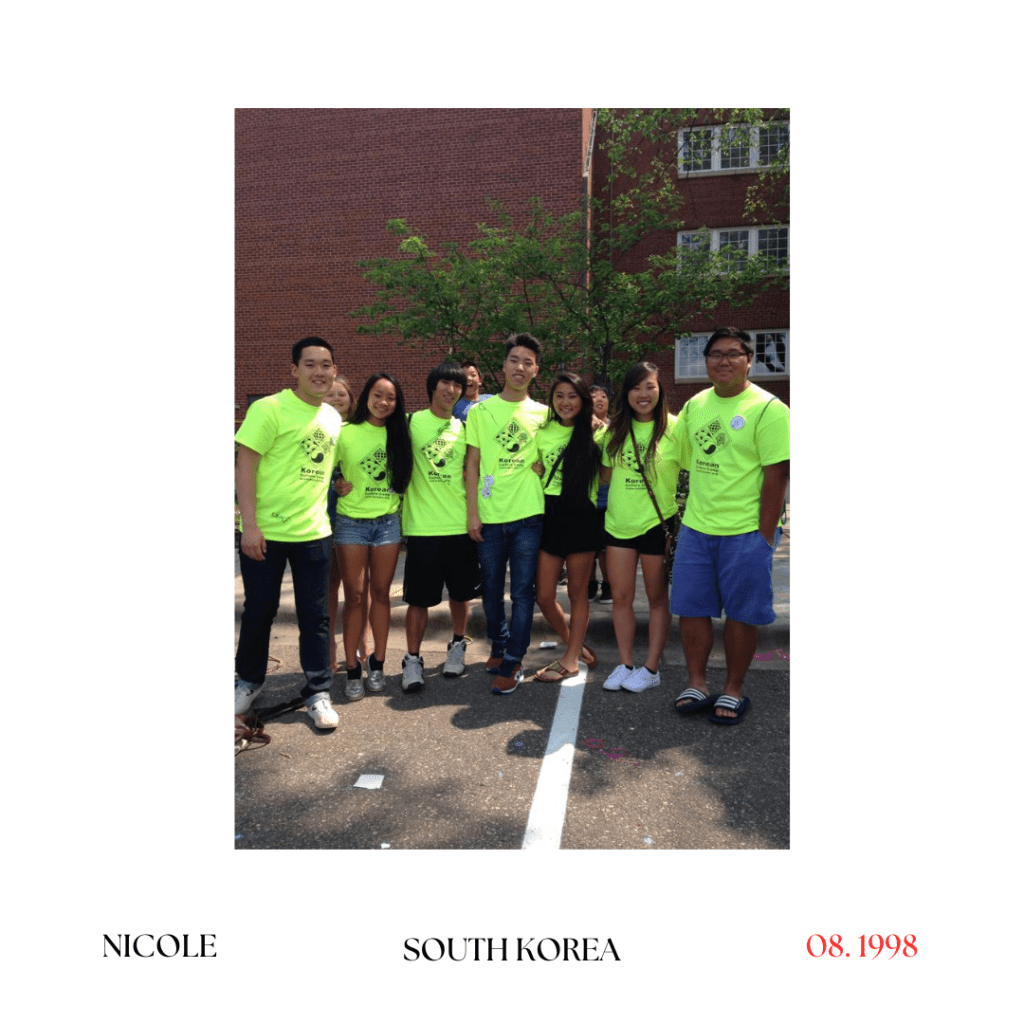
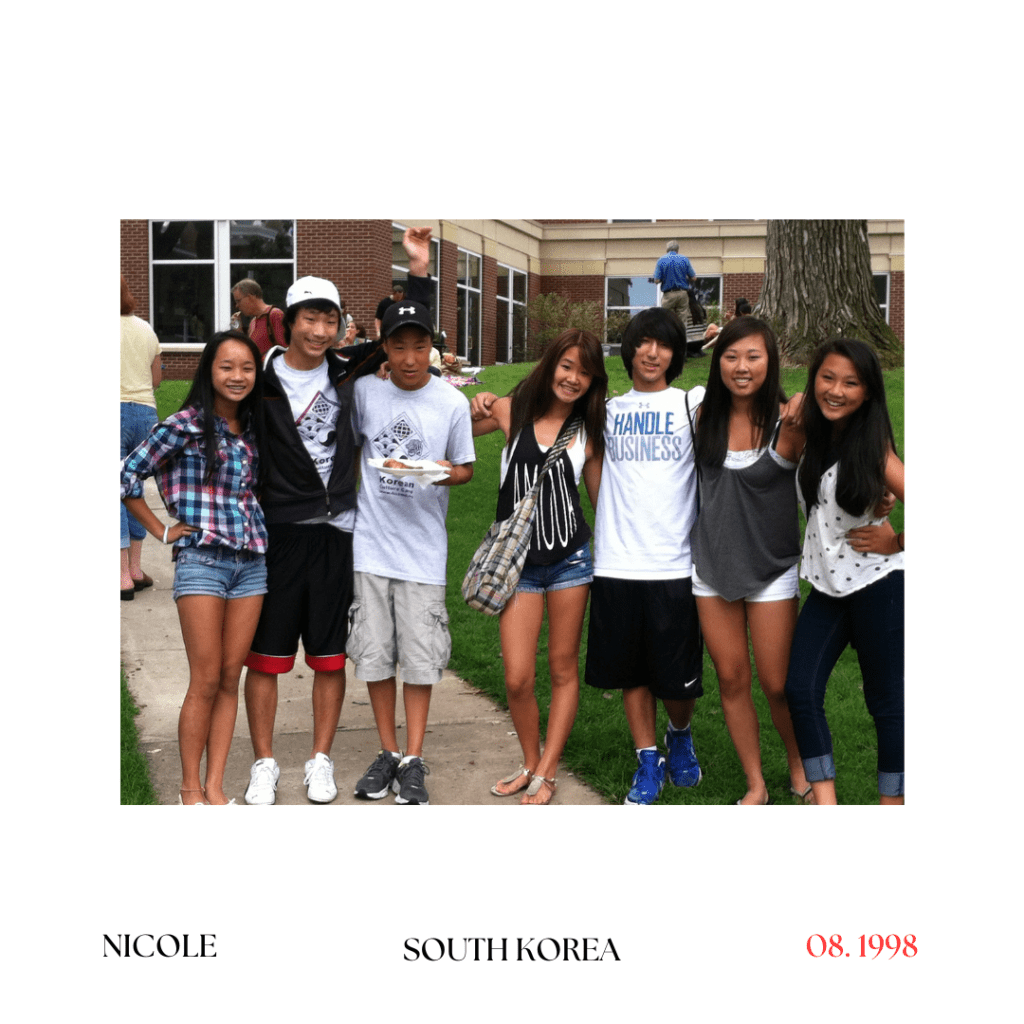
I started going to Korean Culture Camp (KCC) and Korean School (KIM School-Korean Institute of Minnesota) on Saturdays, when I was 8 years old. I remember my mom asking me every year since Kindergarten if I was interested in going to these Korean adoptee camps, but I would say ‘next year I will be ready’. Eventually, I went and I loved those experiences and went to both for about 10 years. KCC was really fun and was a week during the summer where you would get put in a group by grade, and you would go to Korean language class, self-esteem class, dance class, art class, and history class. It was predominantly Korean adoptees and it was the one time a year I could sit in a room where the majority of the people were Korean and not white, which felt so refreshing. The highlight was always seeing my friends each summer and seeing some of the same people who went to KIM school too. KIM school had the same classes, but it was smaller, so I got really close to both the teachers and the students. Chelsie, was my self-esteem teacher for a long time and unknowingly acted as a mentor to me as I have grown up. I have always looked up to her and her fun, relatable, and positive outlook on life which I admire still today. I feel so incredibly grateful for the exposure to Korean people and adoptees I had growing up.
I have this one memory of my self esteem teacher at KCC assigning this project similar to a family tree, but instead of mapping the relevant people in your life, we mapped the relevant moments in our lives. I loved that. We were all pretty young and we all shared the commonality of being adopted, so that was on all of our papers. Our teacher however, showed us her map and told us about the day she had her first child. She went on to explain why that day meant so much to her, she said ‘it was the first day I had ever met someone else who looked like me’. That hit me so hard. I won’t ever forget those words.
In middle school I was bullied and I had a really hard time accepting my differences, but from KCC I made a friend named Cassie, and I ended up hanging out a lot with her and her friends at her school. And since I didn’t look like anyone else at my school, it felt good to have a friend who was adopted. We still stood out, but we got to stand out together.
I got used to so many questions about how my parents were white and why I was Asian, if my sister was also adopted, if I knew my birth parents, why my birth parents gave me up, when I figured out I was adopted, if I wanted to find my birth parents and why, if I wanted to go to Korea and why–it all started at a really young age and it was incredibly consistent throughout my life.
While I was growing up, I used to think a lot about my birth mother, and I didn’t know much about her, but every birthday candle I blew out, every coin I threw in a fountain, I would always wish to meet her. I had it almost rehearsed in my head that when I was 18 I was going to go to Korea and find my birth mother. I had built up this romanticized cloudy idea of how this would go. After a lot of thought and consideration, I decided to do a birth parent search. But instead of those sweet and hopeful feelings I had previously, I felt really nervous and fearful at the potential outcomes. What was once so black and white to me, was gray and murky. I made the decision in the winter of my senior year in high school, and in the spring my parents sat me down and I knew whatever they had to say was going to be about my birth family. My birth father wasn’t able to be found, but they found my birth mother, however she didn’t want to be found or meet me. She wrote me a letter calling me by the name listed in my file. This was important to me because some adoptee’s names are made up by the agency or hospital. At the time I was so happy she was alive and that she named me and took the time to write me a letter. Since then I have felt a lot of feelings about this, grief and anger, and I wish I could say I have since resolved these feelings, but it isn’t that easy.
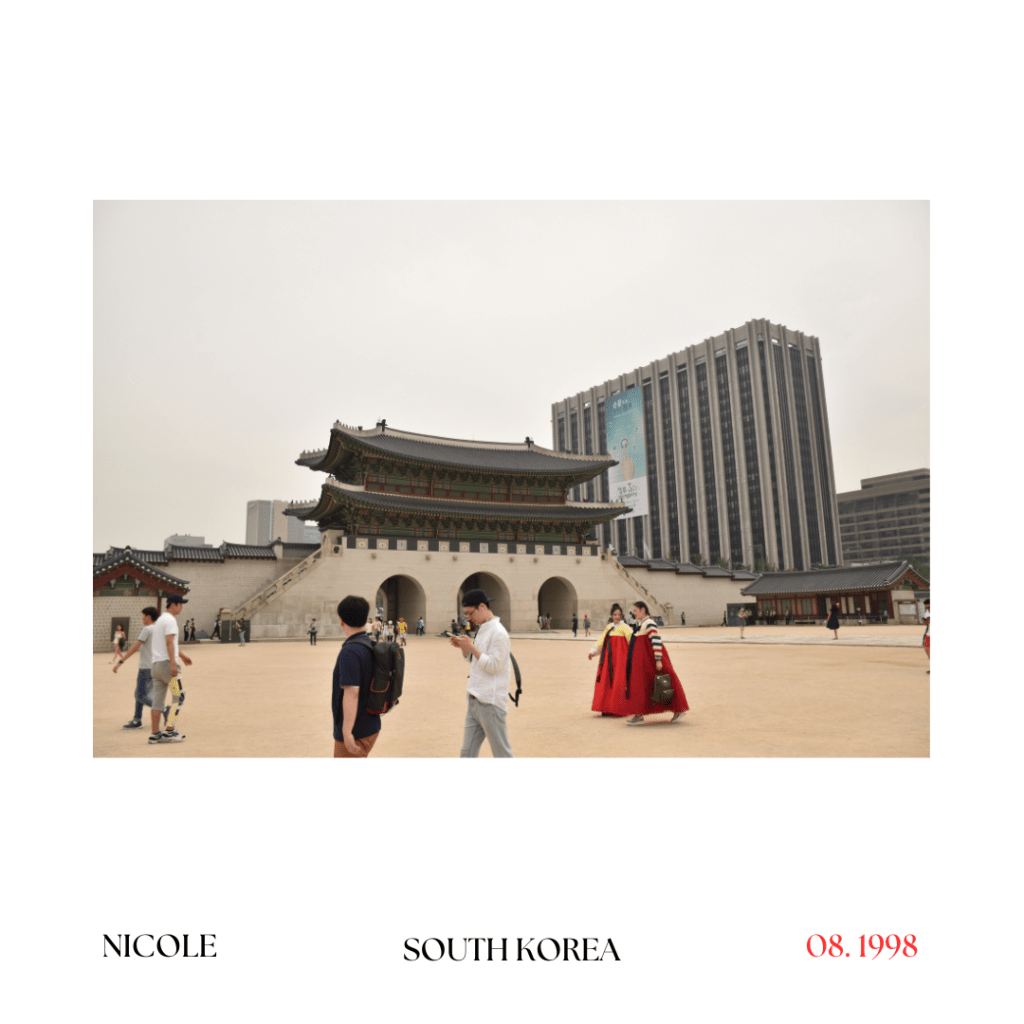
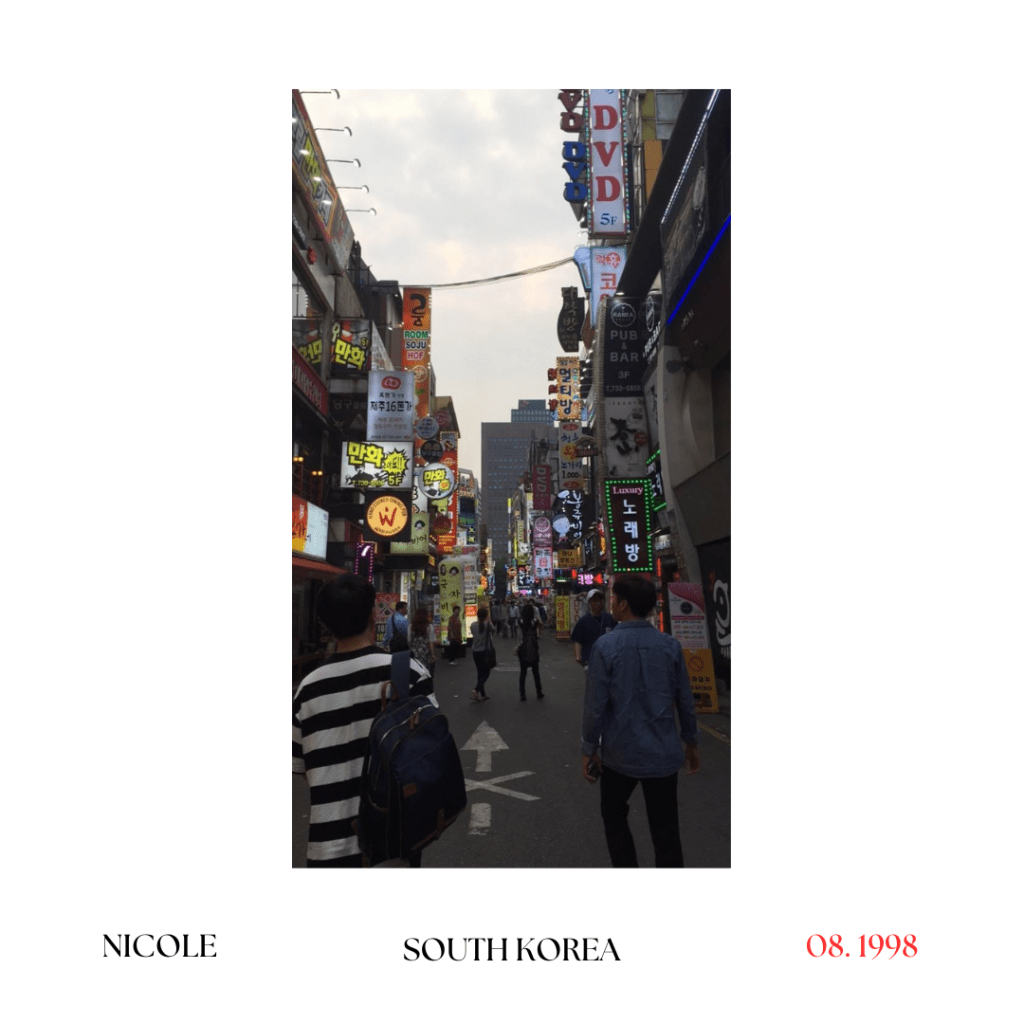
Looking back, it worked out because even if she wanted to meet me, I don’t think I would have been ready to meet her at that time of my life. Anyways, the next month we went on our trip and had a really great time. I loved that experience because there was no stress of figuring out where to go or anything because it was all organized through the adoption agency. The trip is for adoptees and their families, so it was really nice to be with other adoptees on the trip. I made a really close connection with my friend Trevor and it was so special to share some of the emotions of the trip together. I felt like this method of seeing Korea was perfect at the time because I got to experience the adoptee side of things with my adoptee friends and my family could experience their side of things with the other families as well.
I remember one of the adoptees on that trip was able to meet his birth family, and he was a middle-aged adult, so it was really special because of the different practices back when he was adopted. He had his whole family with him, so it was super lovely to witness. This one time I remember us leaving on a bus and we watched him and his family say goodbye to his birth family and everyone on the bus was crying because it was so emotional to see such a heavy and dreamed of moment and live it with our loved ones amongst other adoptees.
On that trip I got to meet my foster mother, which was an experience I am grateful for, but I didn’t think about a lot. It was emotional for my mother and my foster mother, but I remember not knowing what to think or say or do. Coming back from that trip, I felt emotionally drained, and unprepared for the questions I would get. I remember being told it will be more emotional than you think coming home and I didn’t believe it, but they were right. I remember crying and feeling so heavy, like a cloud was over my head and it felt hard to come back to Minnesota after being introduced to the country of my birth. I had no understanding of boundaries at the time and I remember a coworker asked me whether or not I found my birth family, which is a seemingly innocent question, but it hurt me because I shared my experience and he said ‘so she didn’t want to meet you?’ And that stung.
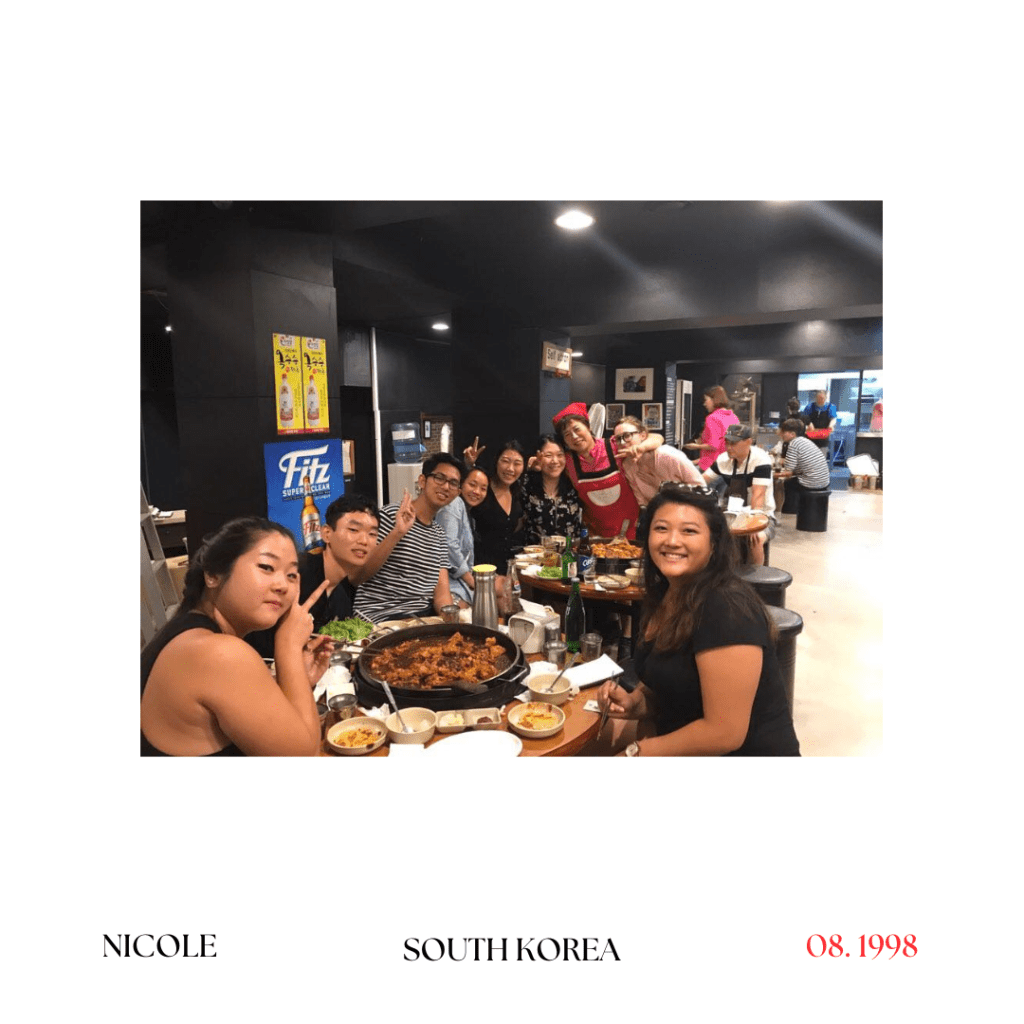
From that trip, I was directed to a language program for adoptees the following summer. Going on that second trip was so far the highlight of my life. I will be forever grateful for it and the relationships I made from that experience I expect to have for life. It was a truly amazing experience. It felt different because I wasn’t there for the first time, I was there to learn the language and enjoy the country. Coming home from that trip was even harder than the trip before. There is a huge indescribable comfort to spend time with other adoptees, it is completely unspoken, and you understand their experiences and pain without saying anything- it’s so visceral. And to not get to be around them as frequently is hard.
Since then, I have been processing my identity as an adoptee. I think the most valuable part of my experiences is exposure and friendships to other adoptees. Simply seeing other people who are adopted, and look like you, goes a long long way. I used to feel so overwhelmed by people’s questions and it was hard for me to understand that I didn’t actually have to answer their intrusive questions. So now as an adult I feel way more in control of how much people get to know about me and my life and experiences as an adoptee.
Growing up in a predominantly white world, I struggled a lot as a kid with how I looked. I think a lot of those struggles were invisible to many people mainly because I didn’t really know what was happening or how to articulate myself. I’ve had a pretty supportive family which I am grateful for, but I do wish I had someone to talk to who was able to understand what I was going through when I was little.
The most pivotal times have been my experiences and relationships I have made through; Korean Culture Camp, Korean School, going on the Birth Land Tour, and going back the next year for the language program.
My aunt and uncle adopted two kids from South Korea as well and those two mean a lot to me. They are 16 and 14. I remember when both of them were adopted and it’s been really amazing to watch them grow up. I would love to go back to Korea with them at some point. I feel really privileged to be in their lives. We don’t even talk about adoption that much, but when we are together, we like to eat Korean food and enjoy each other’s company which is so important to me.
But currently, this project is a pivotal time for me. I think it is a way for me to not only tell my story as an adoptee, but also give other adoptees the space to tell their stories as well. I have been sitting on this idea for about five years now and I feel really grateful to be in a supportive place to create this platform. I mentioned before about the intrusive questions people used to ask me and how since I have established boundaries, and also referenced sharing my story now on social media. There are several differences now though, I am choosing to share my story, and I have already experienced rude questions, remarks, looks, pity, and the list goes on so I am now hoping that my vulnerability helps someone else.
Part of my research and studies have been specific to international Korean adoption. There has been a lot of change in the way international adoption is handled and viewed in the past 20 years. The Adoption Act of 2012, was raised by Korean adoptees making it harder for international adoptions to take place. I do not know the adoptees who pushed for the law to begin with, but I can imagine their pain. I think adoption can be really problematic, and I have seen the repercussions adoption can have on people, with friends that I have met throughout my life, but making it more difficult to adopt seems problematic too. From suicide to different forms of abuse in and outside of the family, adoptees are a statistically vulnerable group of people.
During my undergraduate years, I remember joining Facebook groups for adoptees, and in doing so I read post after post of people struggling with their mental health, and their adoptive families, forming meaningful relationships, etc. So, although, with mainstream media you may see videos of people reconnecting with their birth families or finding a long-lost sibling, but those are the rare stories. There is a spectrum of experiences within the adoptee community and showcasing everything in between the extremes is what has been guiding me. In the relationships I have maintained throughout the years and in witnessing my friends meet their birth families and other friends not meet their birth families and grapple with their identities, is part of the rich lived experience as an adoptee.
My feelings have definitely shifted as I have grown up. I grew up in the catholic church, and many people around me told me that I should be so grateful, that my life here is so much better, that my mother did what she did out of love, that I should be grateful I wasn’t aborted, that I was placed specifically in this family by god. While those things came from good places and displayed people trying their best, the comments really got to me, because my head was filled with these things I was supposed to feel. I was being told how to feel, so much so that I didn’t know what to feel and feeling anything but grateful made me feel really shitty. So throughout my journey with my identity, I have found myself and my voice. In doing so, I wouldn’t be in the place I am at without my adoptee friends, the support of my family and friends, but also my therapist who happens to be a Korean adoptee. After feeling lost about my identity for many many years, I stumbled on my therapist, who I don’t need to over explain myself with because she has lived a similar experience.
I feel happy to be in the place that I am at, but I wouldn’t say I feel divinely placed or chosen. I feel liberated in being able to tell my own story and dictate exactly what it says, with no one’s opinion hovering over me. Overall, I am grateful, but I would say adoption has made it really hard for me. I have had to intentionally face the emotions and heal from the pain directly from adoption. It’s affected my attachment styles in relationships romantic and friendly, and it’s affected my self perception and self worth. But it has also led me down a journey and a path where I get to connect with other people, helping me to feel less alone and more empowered to live my life fully. That, I am grateful for, I am not grateful to be adopted, but more for the depth of friendships and experiences it has brought me.
Do you have any advice for any other adoptees?
I think the best advice I can give is to connect with other adoptees if that feels good and natural to you and work hard to maintain those friendships throughout time even when life gets busy. Without the experiences I have with other adoptees when learning about my culture in various settings throughout my life, I would definitely not be in the place I am today.
Enter your email below to follow along.

© Rebirth Adoptee Stories

 Rebirth